Little Havana, Miami: A Guide to the Neighborhood
Walk Calle Ocho on a Friday night between 12th and 17th Avenues and listen for about ninety seconds. You will hear three different bands, two languages, and somebody’s abuela telling somebody’s nietoto slow down. That is Little Havana, Miami. It is a real neighborhood, about three miles west of downtown, and it is where the largest Cuban community outside of Havana chose to build itself a second hometown.
This page is a guide to the neighborhood: where it is, what to do here, what to eat, what the music is about, and why the whole place still feels like somebody’s family party that you happen to be invited to. Ball & Chain has been on this block since 1935, which is longer than most people have been calling the neighborhood Little Havana. Our address is 1513 SW 8th Street, and if you have a question that is not answered on this page, we will answer it if you call the restaurant.
One honest note before we begin. Little Havana will also try to sell you things. Some of them are very good. Some of them are tourist traps dressed up to look like the real article. Ball & Chain has been here long enough to be neither, and this page is written to help you tell the difference everywhere else.
Where Is Little Havana?
Little Havana is a neighborhood in the city of Miami, Florida, about three miles west of downtown. Its central corridor is SW 8th Street, which is better known by its Spanish name, Calle Ocho. The neighborhood roughly runs from 12th Avenue on the east to 27th Avenue on the west, and from SW 1st Street on the north to Coral Way on the south.
It is not South Beach. South Beach is across the bay, twenty minutes east, and does a completely different job. It is not Wynwood, which is north of downtown and mostly about art galleries. It is not Brickell, which is where the banks are. Little Havana is older than all three, and it is residential as much as it is a destination.
If you are coming from a hotel on Miami Beach or downtown, the fastest way is a rideshare. Parking on Calle Ocho is tight on weekend nights, and the one-way streets in the neighborhood will confuse you at least once. Uber or Lyft will drop you at the door for what you would have paid for valet.
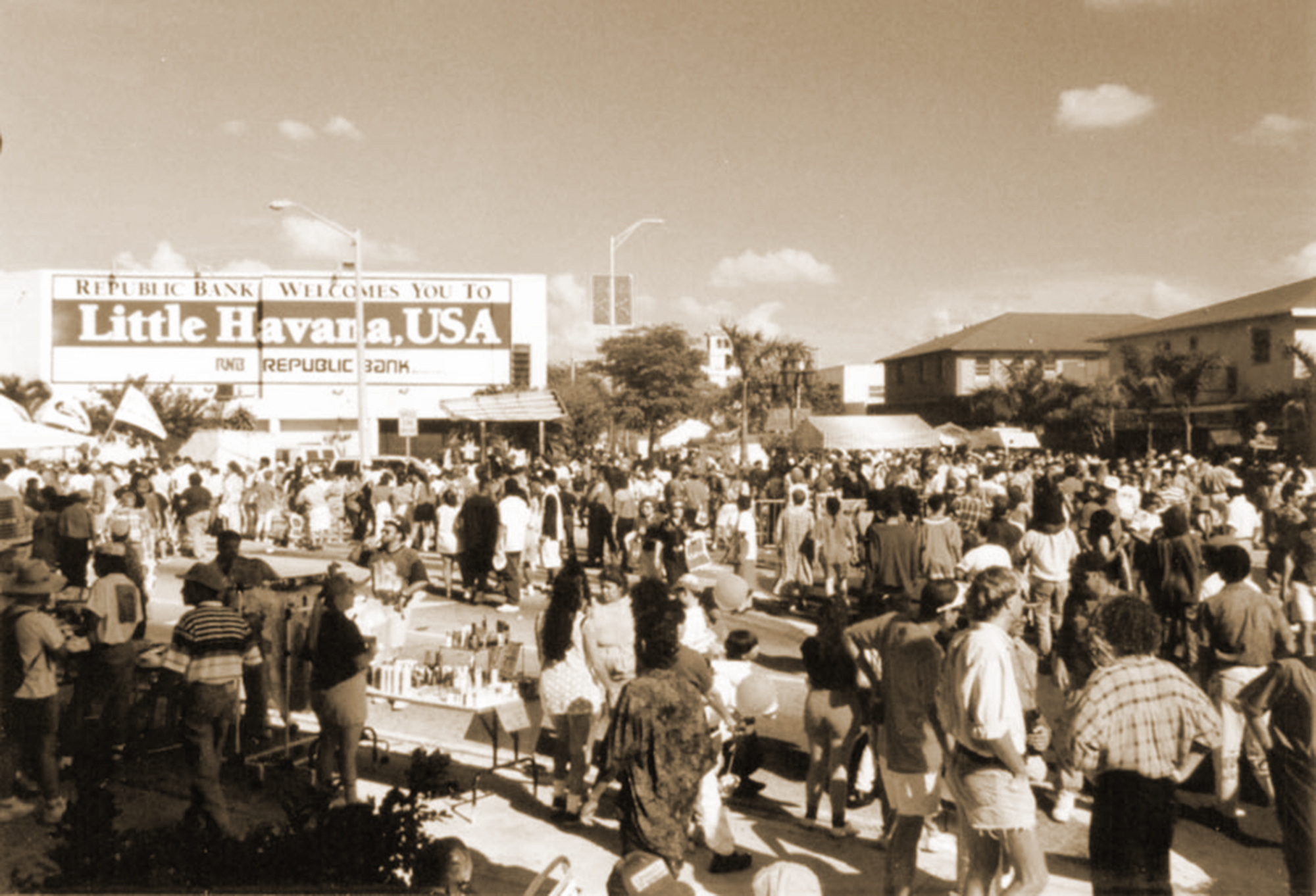
Ball & Chain in Little Havana in the 1960’s
A Short History of the Neighborhood
Before it was Little Havana, this part of Miami was called Riverside, and it was mostly Jewish. Ball & Chain opened here in 1935, decades before the neighborhood got its current name. In that earlier era the venue was a jazz and blues room, with a list of performers that included national acts passing through Miami on tour.
The neighborhood as it exists today begins in 1959. After the Cuban Revolution, and particularly after the Bay of Pigs in 1961, Cuban families left the island in waves and many of them landed here. They opened businesses, restaurants, markets, cigar shops, and the bakeries that still line 8th Street. The Spanish name for the neighborhood is La Pequeña Habana, which translates straightforwardly as ‘Little Havana,’ and it stuck for the obvious reason.
By the mid-1980s the neighborhood was about 85 percent Hispanic and the Cuban influence was total. It has broadened since then. Nicaraguans, Hondurans, Guatemalans, Colombians, and other Latin American communities have added themselves to the neighborhood without displacing the Cuban character of it. Cubans still own most of the restaurants. The bakeries still sell pastelitos de guayaba the way they always did.
Ball & Chain’s own history is its own story — the restoration, the re-opening, the jazz-era lineage. If you are interested in that specifically, the History page covers it. What matters on this page is that the venue is older than the neighborhood’s current name, and has survived long enough to have been part of both eras.
What to Do in Little Havana
Most visits to Little Havana follow the same rough shape: walk the main street, eat something, drink a coffee at a window, eat something else, and end up somewhere with music. The whole trip takes a few hours or a whole night, depending on how committed you are.
So: Walk the main street. SW 8th Street, between 12th and 17th Avenues, is where most of the restaurants, cigar shops, galleries, and murals are concentrated. The street itself — including the Walk of Fame and the Viernes Culturales festival — has its own dedicated page on our site. Give yourself an hour just to walk and look.
Watch dominoes at Máximo Gómez Park. Locals call it Domino Park. Older men in guayaberas play the game for serious money and will tell you exactly how seriously they are taking it if you stand too close. So let them play. Don’t interrupt, don’t take pictures without asking. Do watch from the outside, enjoy the clack of the tiles, keep it moving.
Order a cortadito at a ventanita. A ventanita is a walk-up window, usually attached to a cafeteria, and it is the reason Cuban coffee has a cultural footprint in Miami that rivals the dishes. A cortadito is espresso with a small amount of steamed milk and enough sugar to make your cardiologist unhappy. Drink it standing at the window. This is how Little Havana caffeinates itself between meals.
Visit a cigar shop. Several of the shops on Calle Ocho still roll cigars by hand in the front window. You can watch the rollers work, talk to whoever is behind the counter, and buy a single cigar or a box. The tradition is old and the people doing it are serious. If you do not smoke cigars, it is still worth five minutes to see the work.
See live music after dark. This is where most visitors end up, and this is where Ball & Chain sits. The events calendar shows what is happening this week, and every night of the week has something. More on the music in a minute.
Cuban Food in Little Havana
People come to Little Havana to eat Cuban food. Here’s what that actually means.
The dishes that anchor a proper Cuban menu include ropa vieja (shredded beef braised in tomato, onion, and pepper), lechón asado (slow-roasted pork with mojo, which is a garlic-citrus marinade), croquetas (ham or chicken, panko-crusted, fried), and the Cubano sandwich (roast pork, ham, Swiss, pickles, mustard, pressed flat). The side dishes are moros y cristianos (black beans and rice cooked together), tostones (twice-fried green plantains, smashed), and maduros (sweet ripe plantains, fried until they caramelize). For dessert, flan. For the road, a pastelito — usually guava and cheese, sometimes just guava, always from a bakery rather than a restaurant.
And then there is the ventanita parallel menu, which runs alongside the restaurants. Cortadito, café con leche, colada (espresso in a small foam cup, meant to be shared), guarapo (pressed sugarcane juice), a media noche sandwich if the ventanita also makes food. A good afternoon in Little Havana includes at least one ventanita stop.
The honest part: Little Havana has dozens of restaurants on and near Calle Ocho, and they are not all the same quality. Some are tourist traps with photos of food that does not look like what arrives. You learn to read the signs. The ventanita with a line of locals at three in the afternoon is probably a good ventanita. The dining room with Cubans in it is probably a good dining room. The kitchen that smells like garlic and mojo from the sidewalk is serious about what it does.
Ball & Chain is a live music venue that takes its food seriously. That framing matters. The Cubano here is pressed properly and comes with chips that are made in the building. The croquetas are fried to order. The ropa vieja is good enough that diners who come for the music sometimes stay for a second plate. The drinks program — the mojitos, the Cuba Libres, the frozen daiquiris — is as central to the evening as the food. The full menu has everything, and reservations are recommended on weekend nights.
Music in Little Havana
Cuban music is not background music. It is an argument about what people are for, and it has been making that argument in Little Havana for more than six decades.
The traditions that anchor the scene arrived with the first waves of Cuban immigration, but most of them are older than that. Son came out of eastern Cuba in the early 1900s and became the grammar of nearly everything Cuban that followed. The mambo was invented by Arsenio Rodríguez, who is the reason modern salsa has the shape it does. The cha-cha-cha was invented by Enrique Jorrín. Bolero is the slow ballad tradition. Trova is the folk tradition, usually guitar and voice. All of them are still played in Little Havana, sometimes in the same set!
What this means on a given night: walk Calle Ocho after dark and you will hear three different bands in four blocks. Some are inside restaurants, playing for dinner crowds. Some are outside, on back patios, playing for people who came specifically for them. The sound bleeds from one venue to the next. This is by design. The neighborhood is loud on purpose.
Ball & Chain has live music seven nights a week. Salsa dancing is nightly. Thursday nights are the headline program — Little Havana Under the Stars, which runs from 9pm to midnight and includes a salsa lesson for anyone who wants one. Saturdays are La Pachanga, a full Cuban fiesta that runs longer and louder than any other night of the week. There is no cover charge on any night, which is unusual for a venue of this size and something we’ve never charged and don’t plan to.
A Night Out in Little Havana
A full night looks like this. You arrive around 7pm. You walk the length of Calle Ocho between 13th and 17th, stopping for a cortadito at a ventanita along the way. You sit down for dinner around 8. You move to wherever the music is around 10 or 11. You dance, or you watch people dance, depending on what kind of night you are having. You leave when the bands stop, which on a Saturday might be 2am.
Two practical things. Since there is no cover charge at Ball & Chain, on any night of the week it means you can arrive, look around, and decide whether to stay without committing at the door. Most of Little Havana’s music venues are like this. And the bar opens early — happy hour runs until 7pm with two-for-one house cocktails, which is not widely advertised but is on the menu for anyone who asks.
Come as you are. Most people dress up, because the neighborhood has that kind of energy, but no one will turn you away if you did not. Heels are common and not required. Reservations are recommended for dinner on weekend nights.
Is Little Havana Safe?
Yes. Little Havana is generally safe, particularly the Calle Ocho corridor during the hours when the restaurants and music venues are active. It is a residential neighborhood with a long-established character, and most of the pedestrian activity is revelers, tourists, locals out to dinner, and families.
Like any city neighborhood, it has quieter blocks late at night where fewer people are around. The stretch of 8th Street between 13th and 17th Avenues — which is where most visitors spend their time, and where Ball & Chain sits — is one of the busiest and best-lit parts of the neighborhood. Standard city awareness applies: keep an eye on your belongings, stay on the main corridor after midnight, and rideshare home rather than walking long distances late.
Plan Your Visit
Ball & Chain is at 1513 SW 8th Street, Miami, FL 33135, in the heart of Little Havana. We are open seven days a week, with live music every night and salsa nightly. Book a table directly on our site, or check the events calendar to see what band is playing tonight. For groups larger than eight, or for a private party, our private events team can work with you directly.
Rideshare is the smartest way to arrive. Valet is available on most nights, and there is street parking on the side streets off Calle Ocho if you would rather drive yourself. The neighborhood is walkable once you are in it — most of what you came to see is within four or five blocks.
Frequently Asked Questions
Where is Little Havana located?
Little Havana is a neighborhood in the city of Miami, Florida, located about three miles west of downtown Miami. The main corridor is SW 8th Street, known in Spanish as Calle Ocho, running roughly from 12th Avenue to 27th Avenue. It is one of Miami’s oldest and most culturally distinct neighborhoods, not to be confused with South Beach or Wynwood.
What should I do in Little Havana?
Start with a walk down Calle Ocho between 12th and 17th Avenues, where most of the restaurants, cigar shops, and murals are. Watch dominoes at Máximo Gómez Park. Order a cortadito at a walk-up ventanita window. Visit a cigar shop where the cigars are still rolled by hand. Eat a full Cuban meal at a restaurant with locals in it. End the night at a live music venue on 8th Street.
What is the best Cuban food in Little Havana?
There is no single best Cuban restaurant in Little Havana — there are several good ones, and a few tourist traps to avoid. Look for dining rooms with Cuban customers, kitchens that smell like garlic and citrus from the sidewalk, and ventanita windows with afternoon lines. Key dishes to try include ropa vieja, lechón asado, the Cubano sandwich, croquetas, and tostones. Ball & Chain serves all of the classics alongside its live music program, with a menu built to hold its own in the neighborhood it sits in.
Is Little Havana safe for tourists?
Yes. Little Havana is generally safe for tourists, especially during the hours when the Calle Ocho corridor is busy with restaurants, music venues, and foot traffic. The blocks between 13th and 17th Avenues are the busiest and best-lit part of the neighborhood. Standard city awareness applies — keep an eye on your belongings and take a rideshare home late at night rather than walking long distances.
Is Little Havana the same as Calle Ocho?
Not quite. Calle Ocho is the name of the central street — SW 8th Street — that runs through Little Havana. Little Havana is the whole neighborhood around it. Most of what visitors come to see is on Calle Ocho, which is why the two names get used interchangeably, but they refer to different things: one is a corridor, the other is a neighborhood. Our dedicated Calle Ocho page covers the street itself, including the Calle Ocho Walk of Fame and the Viernes Culturales festival.
When is the best time to visit Little Havana?
Weekend evenings, beginning around 6pm, are the liveliest time. The music venues are in full swing, the restaurants are serving, and the street has the most energy. Weekday nights are quieter but still worth visiting, especially for diners who prefer a calmer meal. Daytime visits are best for the cultural sites — Domino Park, the Walk of Fame, the cigar shops, and the murals. For the full neighborhood experience, plan an afternoon walk followed by dinner and live music.
Do I need to speak Spanish to visit Little Havana?
No. Spanish is the dominant language in the neighborhood, and most of the older residents and business owners speak it first, but nearly every restaurant and shop will accommodate English-speaking visitors without issue. Menus are usually bilingual. The staff at Ball & Chain is fully bilingual. A few polite phrases in Spanish are appreciated but not expected.
Where can I see live music in Little Havana?
Live music is one of the reasons Little Havana exists as a destination, and it plays in venues up and down Calle Ocho on most nights of the week. Ball & Chain features live music seven nights a week with nightly salsa dancing, including Little Havana Under the Stars on Thursdays and La Pachanga on Saturdays. There is no cover charge. The events calendar lists every act for the upcoming week.